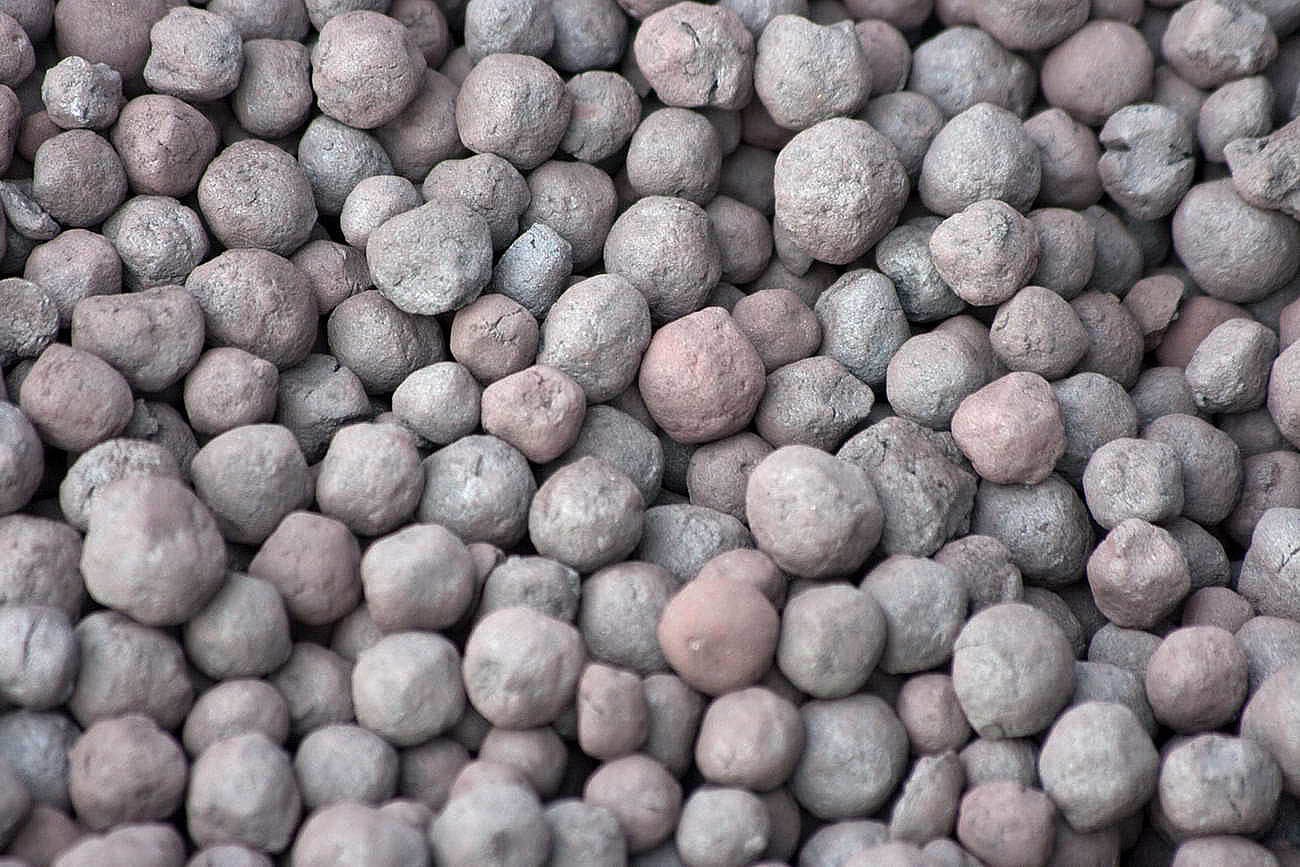
Role of Bentonite in Iron Ore Pelletizing Process
Iron ore concentrates obtained from beneficiation processes typically exhibit fine-grained structures, often with micron-scale particle sizes. Such powdered materials are unsuitable for direct use in blast furnaces or direct reduction (DR) processes due to their poor flow characteristics and tendency to obstruct gas flow within the furnace, negatively affecting process efficiency and operational stability.
Therefore, these fine-grained ores must be physically agglomerated and mechanically stabilized. The pelletizing process, an agglomeration method, transforms micron-sized ore particles into coarse, mechanically stable aggregates before high-temperature treatments.
The primary objective of pelletizing is to produce spherical pellets meeting specific shape, size, and strength criteria, making them suitable for use in blast furnace and DR processes.
Main Stages of Pelletizing
- Blending:
Fine iron ore is mixed with bentonite (as a binder, typically 0.5–1.5%), process water, and, if necessary, recycled pellet fines to create a homogeneous mixture with controlled moisture content (~8–10%). Moisture content is critical, as it directly influences the pellet formation mechanisms. - Pellet Formation (Granulation):
The prepared mixture is rotated in disc pelletizers or drum pelletizers, forming spherical green pellets (unsintered, moist pellets shaped before hardening) through surface tension, cohesion (attractive forces developed by a water film between particles), and the binding effects of bentonite. Pellet size during this stage is controlled by key process parameters such as rotation speed, moisture content, surface adhesion characteristics, and recycle ratio. Optimizing these parameters ensures the desired pellet size and structure. - Drying and Induration:
Green pellets are initially dried under controlled conditions. They are then subjected to induration, a high-temperature hardening process specific to pelletizing that involves sintering mechanisms, at approximately 1200–1350°C. This stage imparts permanent mechanical strength to the pellets.
The type, quantity, and physico-chemical properties of the binder directly determine the pellets’ porosity, mechanical strength, reducibility, and high-temperature behavior. Therefore, selecting the appropriate binder according to process requirements is crucial for pelletizing efficiency and final product quality. Bentonite is among the most widely used binders in the industry.
What is Pelletizing Bentonite?
Pelletizing bentonite is a specialized clay type rich in montmorillonite. It forms a binding matrix between iron ore particles, significantly enhancing pellet shape stability and mechanical strength.
These binding properties, particularly in sodium-type bentonites, result from their high swelling capacity, gel-forming potential, and strong colloidal activity. This refers to their ability to swell upon contact with water, forming a high-surface-area, viscous, and thixotropic suspension. As a result, sodium bentonite exhibits high binding efficiency in pelletizing and plays a critical role in ensuring green pellet strength.
During the green pellet stage, bentonite provides structural integrity by forming bonds between ore particles. After induration, ceramic bonds formed under heat further enhance the pellets’ resistance to cracking and disintegration.
This structural enhancement significantly improves cold crushing strength (CCS). Enhanced strength facilitates better gas permeability in blast furnace and direct reduction processes, directly contributing to overall process efficiency.
Contributions of Sodium Bentonite to the Pelletizing Process:
- Optimizes green pellet strength,
- Reduces required moisture content, decreasing drying time and energy consumption,
- Improves final pellet physical stability and furnace performance.
This exceptional binding capability of bentonite provides both mechanical stability and economic benefits during pellet production, transportation, and storage.
Use of Bentonite in Green Pellet Production
In the green pellet production stage, bentonite creates temporary physical bonds between ore particles, crucially influencing shape stability, particle integrity, and transportability within the process.
Due to its high water retention and plasticity, bentonite facilitates particle cohesion, improving formability. These properties allow pellets to remain intact during granulation and conveyance (drums, conveyors), ensuring shape and size stability throughout the process.
Advantages of Bentonite in Green Pellet Production:
- Increased Mechanical Strength: Reduces the risk of breakage, dust formation, and disintegration.
- Morphological Stability: Maintains pellet shape and size throughout the process.
- Production Efficiency: Minimizes material loss and optimizes production line flow.
Functions of Bentonite During Induration
Green pellets undergo induration at temperatures of approximately 1200–1350°C. During this stage, bentonite maintains thermal stability and structural binding capability at high temperatures, improving pellet resistance to cracking, disintegration, and deformation.
Moreover, bentonite creates controlled porosity within pellets during induration. This ensures homogeneous heat distribution throughout the pellet mass, reducing thermal stresses. As a result, sintering can occur more quickly or at lower energy levels, decreasing total energy usage and enhancing process efficiency.
Advantages of Bentonite in Induration:
- Thermal Stability: Maintains structural integrity at high temperatures, improving pellet resistance to cracking and breakage.
- Energy Efficiency: Facilitates homogeneous heat distribution through controlled porosity, reducing sintering time or energy demand.
- Product Quality: Produces high-strength, uniformly sintered pellets through balanced heat transfer and structural stability during induration.
Frequently Asked Questions
- Why is bentonite used in iron ore pelletizing?
Bentonite forms a binding matrix between fine iron ore particles, enhancing green pellet shape stability and mechanical strength while reducing risks of cracking and disintegration during induration. - What is the induration process?
Induration is a high-temperature thermal hardening process (approximately 1200–1350°C) unique to iron pelletizing, wherein green pellets gain permanent strength and structural stability through sintering mechanisms. - What advantages does bentonite provide in pelletizing?
Bentonite use:
- Enhances green pellet strength, preventing disintegration on the production line,
- Reduces risks of cracking and deformation during sintering,
- Improves heat transfer through controlled porosity,
- Increases process efficiency by reducing energy consumption and producing a stable final product.
SAMAŞ Bentonite in Iron Ore Pelletizing Process
Natural sodium bentonite produced by SAMAŞ, Turkey’s leading bentonite manufacturer, provides superior performance throughout the pelletizing process, from green pellet formation to induration. It significantly enhances the mechanical strength, dimensional stability, and operational reliability of iron ore pellets.